


Top 10 Attractions in Tashkent | What to See in Uzbekistan's Capital
Tashkent is one of the oldest cities in Uzbekistan and the largest in Central Asia. This flourishing, young-looking capital represents a rich chronicle of two-thousand-year history, culture and architecture — a curious blend of modernity, antiquity and touches of Soviet modernism. Tashkent is a symbol of hospitality, proven by the warmth and generosity shown to evacuees during World War II. That goodwill was returned in kind when friends from every corner of the Soviet Union came selflessly to rebuild the city after the 1966 earthquake, which left a million residents without homes overnight.
Tashkent enjoys a mild climate thanks to its location in the Tian Shan foothills — the peaks are visible on clear days, and walking here is comfortable in any season. Everyone will find countless places worth visiting for an engaging and enriching time. Tashkent's distinctive character is not obvious at first glance, but it invariably captivates once you look a little deeper. Don't be in a hurry to leave before you get to know it. Here are the Top 10 attractions in Tashkent:
1st place: Khast Imam Religious Complex — Tilla-Sheikh Mosque and Kaffal Shashi Mausoleum
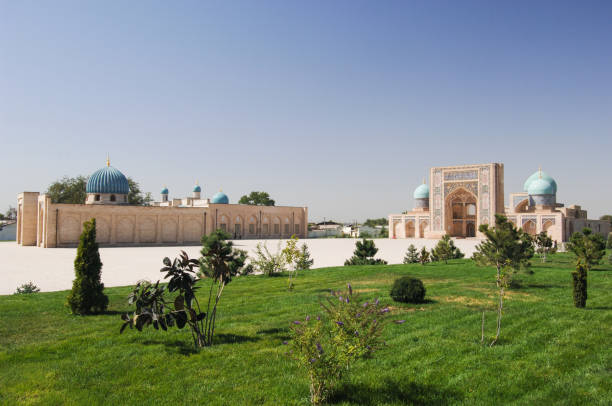
The Khast Imam Complex is the historical centre of old Tashkent, adjoining the narrow streets of authentic mahallas. It grew up around the burial place of the city's patron saint — Abu Bakr Muhammad Kaffal Shashi — who saved the settlement from a bloody inter-religious war through his deep faith, extraordinary wisdom and broad knowledge. After the Arab conquest of the 8th century and the destruction of the capital of Tsar Chach, this site became the centre of Muslim civilisation.
The Tilla-Sheikh Mosque was built in the 19th century. Its founding history is intertwined with the Kokand Khanate and its ruler Mirzo Akhmedom Kushbegi. For his true faith and integrity he was given the name "Golden Sheikh" — the same name was inherited by the mosque he built, which became the main Friday mosque, known as Pyatnichnaya. The building, adorned with ornamental architectural style, carved lattice "pandjara" windows and mosaic on the walls, is framed by two minarets — built to traditional canons with no lifts, only spiral staircases for the ascent.
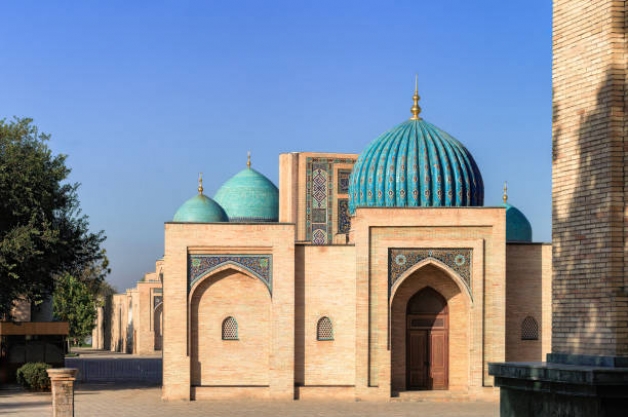
On the square stands the Barak-Khan Madrasah, built in 1532 during the reign of Navruz Akhmed-Khan of the Sheibanid dynasty — descendants of the Timurids. Akhmed-Khan dedicated the building to a teacher who had raised the Tsarist family long before the throne. The building is made of fired brick with coloured mosaic on the facade, with ornate gates and ornamental painted ceilings, which house rare handwritten books crafted by local masters. From here you can admire the trio of blue domes of the madrasah, perfect for photographs.
The Quran of Caliph Uthman is kept in a special hall of the Muyi Muborak Madrasah — a unique manuscript of the 7th century, whose impressive dimensions (53 by 68 cm) and 338 parchment pages made from deerskin are stained with the blood of Caliph Uthman, who was killed by pagans while reading the Quran, after which centuries of wandering of the relic began across the collections of rulers. Returned to Uzbekistan thanks to Tamerlane, in the 19th century the book was taken to the imperial library in St. Petersburg. The madrasah building was converted into a museum and serves as a library for 20,000 manuscripts. In a special case, carefully protected from visitors, lies another holy relic — the Golden Hair of the Prophet Muhammad.
On the territory stands the Tashkent Islamic Institute named after Imam Al-Bukhari — an institution of higher spiritual education. Students study the heritage of great scholars and prepare to contribute to its development.
The open space with exotic plants invites leisurely walks, and at the golden hour before sunset mass photo sessions take place here — each spot more picturesque than the last. The charm is further enhanced by the abundance of intricate hand-crafted decorative details that adorn portrait shots. If you are lucky, a deer — a resident of these grounds — may appear in your frame. It is worth visiting in the evening too — floodlighting magically creates a fairy-tale aura around the medieval buildings. This magic attracts young visitors from among the local residents, so take a moment to observe the everyday life of people out for a family stroll. If you wish, you can even strike up a conversation — Uzbekistanis are remarkably welcoming to guests. A visit to Khast Imam is recommended to those who reproach Tashkent for lacking an Eastern atmosphere — read more via the link.
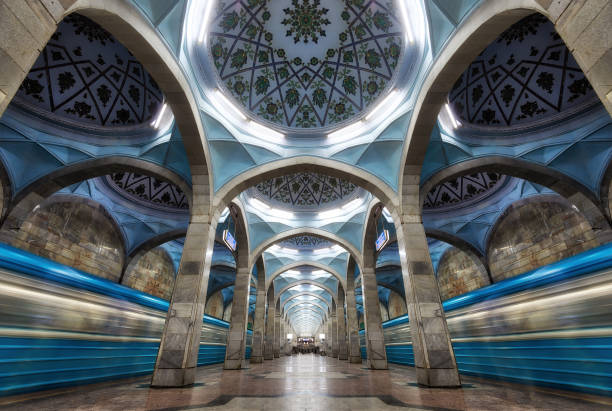
2nd place: Tashkent Metro — one of the most beautiful in the world
The Tashkent Metro, opened in 1977, impresses not only with its cleanliness bordering on sterility, but also with its magnificent architecture. The Tashkent metro is unlike any other, thanks to the quality of the materials used for its extraordinarily artistic interiors, possessing their own unique charm. The walls, columns and floors are decorated with coloured marble and granite in delicate shades — all of this, together with painted ornamental ceilings, domed vaults, figured bronze bas-reliefs by sculptor Yakov Shapiro, glazed ceramics and crystal, thematically styled light fittings and dazzling chandeliers, allows the stations to be fully called works of art. A phenomenal underground museum stretching from the far corners of the capital and concentrating on the central stations with its sumptuous chandeliers, created as if by a single hand, to preserve for future generations an aesthetic synthesis of Soviet heritage, traditional culture, and contemporary art.
The Tashkent Metro is the seventh in the USSR and the first to appear in Central Asia (and to this day the largest). It was built with the seismic zone and high humidity in mind due to the proximity...a gift from UZSSR leader Sharaf Rashidov and the Soviet government to the city destroyed by the earthquake, it was built in just 5 years and has not closed once in 46 years (except lockdown).
Many of the capital's guests, their parents, grandmothers and grandfathers who visited here in Soviet times, have memories close to their hearts connected with the stations of the first — Chilanzar — metro line. The Kosmonavtlar station is an absolute Instagram hit with its futuristic motifs — images of medieval Uzbek astronomer Ulugbek, as well as the first space explorers Yuri Gagarin and Valentina Tereshkova. «Buyuk Ipak Yuli», which translates as "Great Silk Road", may confuse with its design — far removed from the recognisable symbols of ancient caravans. The thing is, the station's current name was assigned only in the years of Independence — it was previously named in honour of writer Maxim Gorky (and locals still use that name in everyday conversation). The literary theme is very commonly used both in station names and in décor concepts. Among the constellation of outstanding Uzbek writers and poets, Hamid Olimjon and Alisher Navoi are not forgotten, nor is the universal legacy of Pushkin. On the Chilanzar line, a garland of candle-shaped lights burns in honour of Alexander Sergeyevich, confirmed by a bronze panel bearing the writer's image. Immersed in the atmosphere, it seems that the breeze you feel is not from an approaching train — it is the spirit of creativity itself. The Mustakillik Maydoni (Independence Square) station appears filled with light and air thanks to its marble décor with alternating shades of white and pale pink.
In 2026, Tashkent has 48 stations on 5 lines, but the expansion of the metro network continues — read more via the link.
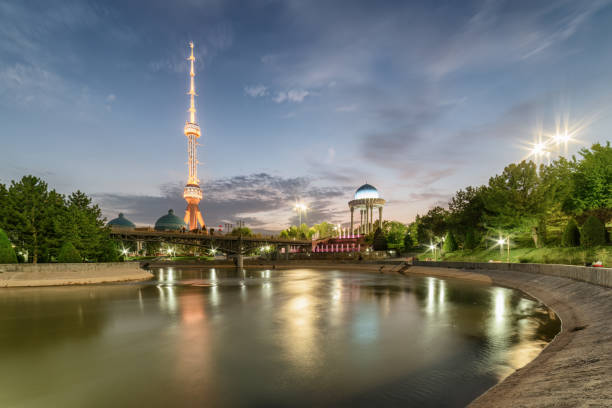
3rd place: Tashkent TV Tower — a magnificent giant on three columns
The magnificent Tashkent TV Tower, standing 375 metres tall, with its illuminated multicoloured spire visible from any point in the city, serves as a beacon for travellers following in the footsteps of the caravans of the Great Silk Road. You can reach it by metro — exit at Bodomzor station on the Yunusabad line.
Take the high-speed lift, travelling 4 metres per second, up to the observation deck on the 6th floor at a height of 100 metres, to admire the impressive panoramic view of the capital. Visually, this is the first "ring" of the tower. To examine points of interest more closely, use the installed binoculars with 30x magnification. From here, the snow-capped Chimgan mountains are visible — if possible, choose a clear day for your visit.
The tower was built in 1985, and visiting it immediately became a cult ritual for every resident and guest of the city. The romantic "celestial" restaurant Koinot on a revolving platform, situated 5 metres above the observation deck, became truly legendary — in Soviet times, during holidays, admission was by invitation only. Muscovites will easily note its similarity to the "7th Sky" at Ostankino. Today, the tower restaurant has two halls: the "red" one is more fast-food oriented and budget-friendly, while the "blue" one meets the criteria of fine dining and is open to everyone. The restaurant platform completes a full rotation around its axis in one hour.
The lobby features an exhibition of extraordinary miniatures — TV towers from around the world with their heights described. In the global ranking, the Tashkent TV Tower holds 12th place by size.
Equally fascinating is the story of how the tower came to be built in Tashkent — the project was originally developed and approved for Baghdad, but following a coup in Iraq, it was never realised there. The architects, when adapting the project, paid close attention to seismic resistance — the tower was built to withstand an 8-point earthquake. It thus became the third TV tower on Soviet territory (both historically and by height) after Ostankino and Kyiv. Its Eastern origins are recalled by the distinctive motifs in six mosaic panels made from natural stones and glass decorations used in the interior finishing.
The lower part of the structure looks unusual due to its three supports — creating the impression that it is floating in the air — read more via the link.
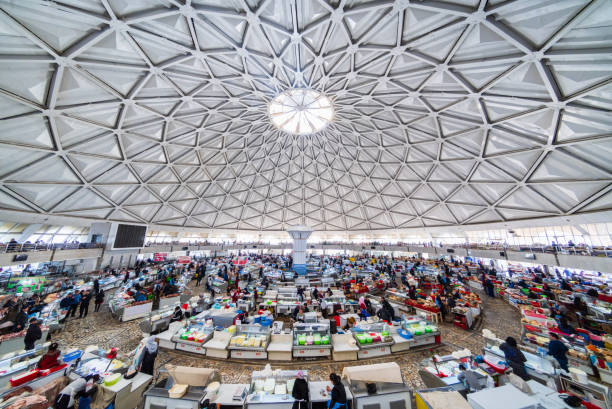
4th place: Chorsu Bazaar — a thousand-year-old culture of trade
Chorsu Bazaar is one of the oldest and largest markets in the country and Central Asia, participating in the Great Silk Road. It is located in the very heart of the old city. What can you buy under the vaults of its blue dome, spread across 350 metres? Everything that is associated with Uzbekistan:
- fresh vegetables and fruits
- fragrant hot flatbreads from the tandoor
- dried fruits
- spices
- Eastern sweets
- elements of national clothing
- souvenirs at democratic prices
- ceramics from the leading craft schools
Among the countless trading rows, stalls, and shops, it is easy to get lost and lose track of time. And it is worth it, even if you would not call yourself a shopaholic. Trade is an inseparable part of the cultural code of Asia, and this is the best place to experience it. Valuable observations await even on a casual stroll here, but if you decide to immerse yourself in the immediate process of traditional bargaining, you will gain important experience and vivid impressions. The Eastern bazaar, like nothing else, demonstrates the temperament of the locals, the format of interaction and the way of life — read more via the link.
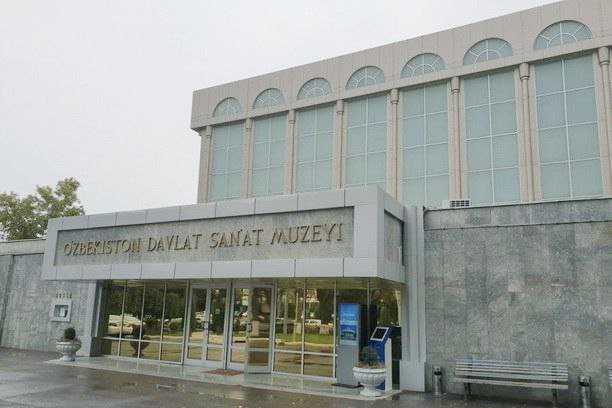
5th place: State Museum of Arts of Uzbekistan
The largest and oldest art museum in Central Asia, founded in 1918. The modern aluminium-clad building with a grey marble plinth was built in 1974. Panoramic glazing lets in comfortable natural light.
The original cubic building in the modernist style with an understated facade houses a unique exposition of treasures of ancient Central Asian and antique marble sculptures, as well as an impressive collection of Russian avant-garde artists, Peredvizhniki and Western European paintings, Japanese ukiyo-e woodblock prints, graphics, ceramics, Chinese porcelain and the glowing lights of Eastern jewellery.
A journey through the halls of the four-storey museum passes through 3,000 exhibits that reflect like a mirror the cultural heritage of Uzbekistan and the stages of its development. The museum's collection was initially formed from the rare artistic holdings of Grand Duke Nikolai Konstantinovich Romanov, grandson of Russian Emperor Nicholas I. 500 exhibits were bequeathed to the beloved city and displayed in his palace after the death of the prince.
Over the course of a century the collection has been replenished with new acquisitions from Russian museum collections. Here is concentrated a first-class collection of Russian avant-garde — the founders of abstractionism Vasily Kandinsky and Kazimir Malevich, as well as the expressionist Yavlensky.
From 1935 the formation of Uzbek art collections began — the exposition features creative works by Benkov, paintings by Karakhana, landscapes of Samarkand, Bukhara and Tashkent by Ivan Kazakov. The incomparable collection is also represented by works of decorative and applied art — read more.
6th place: Independence Square "Mustakillik Maydoni"
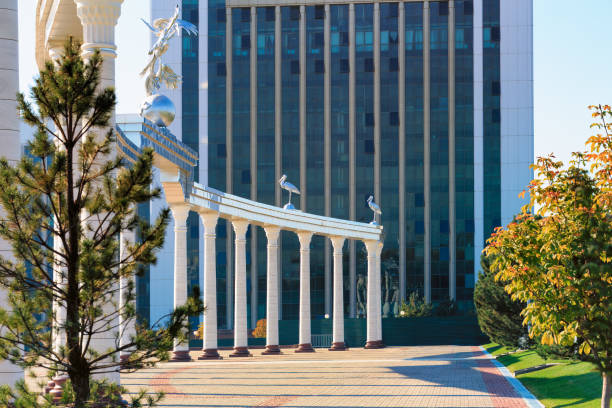
Independence Square "Mustakillik Maydoni" is the heart of new Uzbekistan, with the eponymous monument in the form of a globe at its centre. The globe symbolises the Earth, with the outline of Uzbekistan engraved upon it as a symbol of the country's unity with the international community. The central fountain differs from the others in its white colour and is called "Ok Yul" — "Good Path."
From its very foundation, even under the rule of the Kokand Khans, this place was the centre of power. After the capture of Tashkent by the Russian Empire, the "White House" was built here — the residence of the Turkestan Governor-General. In Soviet times this became a likeness of Moscow's "Red Square," where a bust of Lenin stood, and during holidays ceremonial parades were held. Continuing the tradition, modern government institutions are also located here — the Cabinet of Ministers and the Senate.
But it is not only for official purposes that residents flock here on hot summer evenings — all the business is in the cascading fountains stretching along a long wall and the shady park alleys, offering cool relief.
From a distance, 16 classical marble columns of the arch "Ezgulik" are visible — these are the "Good and Bright Aspirations," crowned by storks rising upwards. The stork is an ancient symbol of gratitude in the East. Despite the youth of the structure, its appearance has served as the foundation for a new superstition — it is believed that if you make a sincere wish here, the storks will carry the dream to the heavens.
The square is particularly lively during New Year and Navruz celebrations. On 9 May, "Day of Memory and Honour," visitors gather at the "Eternal Flame" monument with the "Grieving Mother" memorial — representing the Motherland mourning her children who perished in the years of the Second World War. In honour of the heroes, a gallery of books has been installed beneath the vaulted carved columns, whose golden pages preserve the names of the fallen — read more.
7th place: The Solar Institute — an extraordinary attraction beyond the city
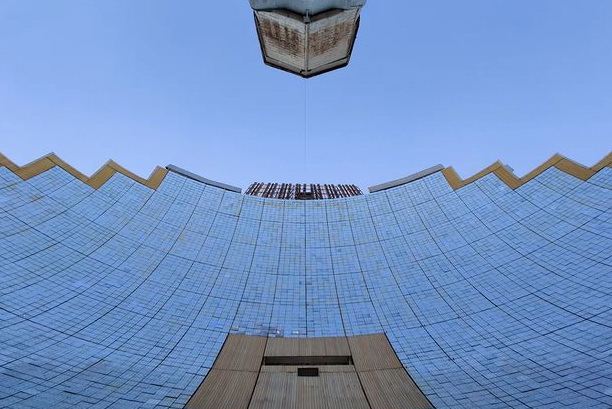
The Heliocomplex in the Parkent district, 45 km from the capital, was built in 1987 at an altitude of 1,000 metres. Soviet physicist Sadyk Azimov stood at its origins. The scientific research complex was created to observe the evolution of the Sun, its influence on climate and human beings. The Solar Institute fulfils practical functions — the extraction of solar energy. There are only two such institutions in the world — in Uzbekistan and in France. Until 1993 the doors of the heliocomplex were not open to the public — the classified project was carefully guarded.
The complex represents the largest solar furnace in the world with a focusing parabolic mirror 54 metres high and 64 rotating heliostats directing beams into a technological tower. Heating to 3,000°C occurs in a fraction of a second, which is used for melting metals, testing spacecraft hulls and rotor blades of aircraft, as well as for producing bioceramics for medical purposes. Producing hydrogen H20 at these temperatures will become the most budget-friendly and environmentally friendly energy resource. Tourists can independently witness scientific discoveries first-hand through a small furnace specially designed for mini-experiments — where a small object burns before your eyes without any apparent external influence, as in a science fiction film.
Local guides will tell you in detail about the work of the institute and demonstrate the most important principles of the complex's operation using models — a process that even schoolchildren find comprehensible. In the museum exhibition hall, visitors are greeted by a unique chandelier made from glass named "Hymn to the Sun" — the artist is glass-stained artist Irena Lipene from Lithuania. Her other works can be encountered at Mustakillik Maydoni, Hamid Olimjon and Pushkinskaya metro stations, as well as in the Koinot restaurant at the Tashkent TV Tower. The scientific complex also displays two more of her works — "Luna" and "Parade of Planets," consisting of four parts, the size of a door, dozens of stained glass flights.
Take photographs in the extraordinary mirror labyrinths and take the lift to the observation deck located on the 12th floor at an altitude of 1,100 metres — from there an impressive view of the mountains opens up. The location of the scientific complex in the mountains is due to the auxiliary properties of clean air with a high concentration of light.
8th place: State Museum of Applied Arts of Uzbekistan
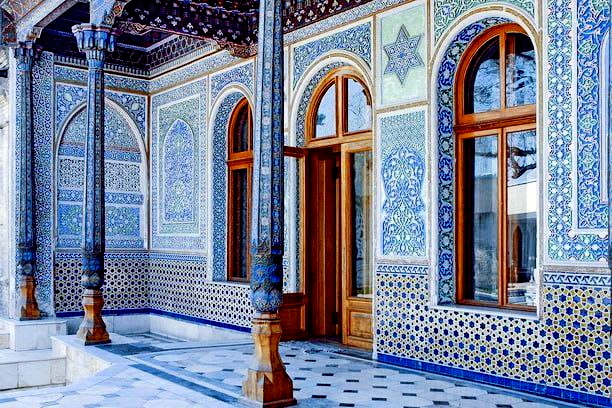
The Museum of Applied Arts of Uzbekistan was founded in 1937 in a historic palace building commissioned by entrepreneur Nikolai Ivanov. The impressive design of the building — decorated with wood and ganch carvings — was then enriched with a magnificent painted ceiling by Russian diplomat and ethnographer Alexander Polovtsev the Younger. The palace is a standalone work of art in its own right. Such celebrated masters as Tashpulat Arslankupov and Bukharan artist Usta Shirin Murodov worked on it. Not knowing its purpose, one could easily mistake the building for the residence of an emir. The museum is within walking distance of the city centre, not far from Kosmonavtlar metro station.
The museum collection holds 7,000 irreproducible examples of Uzbek applied art — they reflect the chronicle of the development of artistic talent and craft labour of the people from the beginning of the 19th century. The collection, represented by craft schools of Tashkent and Samarkand, Bukhara, Surkhandarya and Syrdarya, Fergana and Karakalpakstan, demonstrates regional distinctions and the cultural characteristics peculiar to them — which will help you form a rich overall picture from the details.
The complex offers the opportunity to explore embroidery hand-crafted from cotton, silk and gold threads. Embroidery adorned national clothing, tubeteikas, turbans and even boots. A special place among them is occupied by suzane — patterned panels with a plot-ceremonial composition, which formerly decorated the walls of every home, as girls embroidered textiles on the threshold of marriage. The exposition is divided into the following collections — read more.
9th place: Romanov Palace
The Palace of Grand Duke Nikolai Konstantinovich Romanov is located opposite Independence Square. Built to his commission in 1891 — the Prince personally made corrections to the project, where the main principles were not luxury or even comfort, but the appropriate housing of his expensive collection of works of art. The remaining elements were entrusted to the outstanding architects of their time — Benois and Geizelman. The creative symbiosis of two geniuses produced a modernist masterpiece. In the design, the Prince's main passions in life found their place:
- Hunting — statues of dogs and deer decorate the estate park
- Art — rare exhibits from the collection are displayed in halls that in no way yield to the artistry of the décor
- Travel — reflected in the wings of the palace with Eastern and Western themes
The Prince found himself in Tashkent after a decade-long exile — the return to Turkestan was the personal wish of Nikolai Konstantinovich, so greatly had this Asian land impressed Romanov during the Khivan Campaign. His exile was directed by none other than representatives of his own family from the crowned Romanov dynasty. The pretext was an unclear story of the theft of diamonds from the frame of a wedding icon of his parents, the perpetrator of which was identified and named Nikolai. The complexity in judging the true reasons was compounded by both the tense atmosphere in the imperial family home and the anxious atmosphere of the entire imperial house — questions of succession had more than once stood above spiritual values.
Even during his lifetime the Prince wished to acquaint anyone interested with the art, so the residence served not as an impregnable fortress-refuge but rather as a museum. The palace doors opened to guests regardless of their social standing, and an excursion with a detailed account of the exhibits and the history of their appearance in the collection was conducted by the Prince himself. Such was the bequest of Romanov — to hand over the palace and all its relics to the city. The worthy desire of the Prince was fulfilled — the first art gallery in Central Asia appeared here. Due to the transfer of the palace building to the Ministry of Foreign Affairs, the exposition can now be viewed at the State Museum of Arts. However, the return of the palace to public access is expected soon — preliminary works combined with partial reconstruction have already begun — read more.
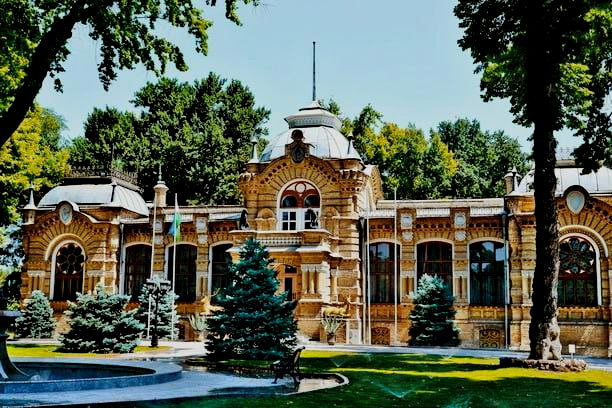
10th place: The Mountains — Greater Chimgan and Charvak Reservoir
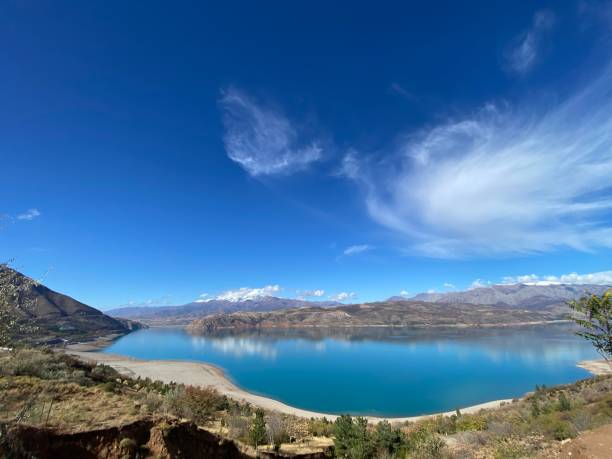
The mountain zone in the spurs of the Western Tian Shan with the reservoir is located just 90 km northeast of Tashkent. The distance, covered in 1.5 hours by car, transforms Greater Chimgan and Charvak Reservoir into the main locations for all-season recreation for residents and guests of the capital seeking entertainment, communion with nature, freshness and a change of scenery. For the picturesque beauty of the surroundings it is called the "Swiss Switzerland," rising to 1,600 metres above sea level.
Its popularity is reflected in the offerings from hotels, surpassing in assortment, quantity and quality all the rest zones of recreation in Uzbekistan taken together. The Charvak shoreline — an artificial reservoir formed by a dam across the Chirchik River, stretching for 100 km — is densely covered with resorts, camps, sanatoriums, rest houses and guest houses of various budgets and concepts. Nevertheless, the annual number of those seeking salvation from the summer heat in the mountain fresh air and the azure waters of the lake exceeds supply — so advance booking is strongly recommended. The indescribable effect when through the uniform mountain serpentine before your eyes suddenly opens the blue mirror of Charvak — the largest reservoir in the country in terms of water area, compensating for the absence of the sea.
Since Soviet times Chimgan has been known as a ski resort, which did not stop those wishing to slide merrily down the slopes on skis and sledges, and even on inflated car inner tubes.
Over time, mountain hikes and traditional beach entertainments were joined by extreme activities such as paragliding and jet skiing. But hiking and trekking here never went out of fashion — besides the wonderful slopes with waterfalls, crystal streams, lush grasses and flowering poppies, trails for walks are available and monuments of ancient art — the Beldersay petroglyphs of the Bronze Age.
In a number of locations picturesque gorge roads have appeared. The closest to Tashkent, 65 km away, is Chinorkent. It is worth coming here with the whole family — a children's playground and the presence of reputable establishments will make for a pleasant and memorable time after descending from the zip line.
At the same distance, in the Bostanlyk district, a world-class mountain resort Amirsoy has been established, welcoming guests year-round across 900 picturesque hectares of the Chatkal ridge. Positioning itself as a ski complex with underground cable cars and pistes suitable for skateboarders of all ages and skill levels — from professionals to beginners trying these sports for the first time. Like a skating rink, the slopes operate from December to March and are accompanied by instructor services. In the warm seasons the mountains are conquered on the cable car and quadricycles, and no less actively explored by hikers and picnic lovers. 48 chalets in alpine style, restaurants of European and national cuisine, as well as a SPA complex allow for full recovery after a full day.
To get a well-rounded understanding of the city, you need to go beyond the traditional lists of attractions. Among these are museums with less widely-known but genuinely deserving exhibitions, park zones combining education and entertainment — something that will appeal to both children and adults. Here is what else Tashkent has to offer:
WORTH KNOWING:
Kukeldash Madrasah — the largest in medieval Tashkent
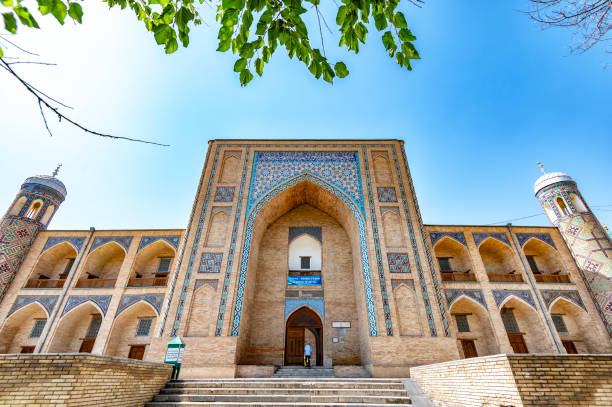
The functioning Kukeldash Madrasah was built by the vizier of the Tashkent rulers Barak-Khan and Dervish-Khan in 1569 during the Sheibanid dynasty on Chorsu Square — an analogue of the Samarkand Registan. Dervish-Khan was the milk brother of Barak-Khan — this fact is connected with the origin of the madrasah's name.
Getting to know it gives an understanding of the structure of traditional madrasahs and the life of students living in ascetic cells-hudzhras, isolated from the temptations of the outside world. The building historically neighbours the Friday mosque of Khoja Akhrar and Chorsu Bazaar — infrastructure dating back centuries that served the needs of those studying here.
The madrasah, standing on a hill, once shone with the brilliance of the Chacha fortress — it absorbed the destructive force of the earthquakes that struck Tashkent in 1868 and 1886. The 15-metre portal and the side towers "guldastas" collapsed and lay in ruins for a century, managing to acquire legends along the way. For example, a popular folk belief holds that the towers were used as a prison — in actual fact, the call to prayer was announced from them at the time of prayer. Restoration began in Soviet times. The ornamental decoration of the facade with blue majolica and laid-out star-shaped five and ten-pointed polygons, as well as plant motifs, was carefully reconstructed from photographs of the original — but the two original domes were never restored. Continue reading.
MUSEUMS OF TASHKENT
State Museum of History of the Timurids
The State Museum of History of the Timurids is the youngest museum in the country, built in the centre of the new, European part of the city in record time — nine months. Dedicated to the phenomenal military commander Tamerlane and his descendants — the connection can be traced on a stylised genealogical tree. The exposition features exhibits of the Bronze Age, as well as fragments of the most extraordinary works of art of the Timurid era. The style of the three-storey building is a mix of traditional architectural solutions characteristic of the Timurid era and contemporary findings — reflected in the round form of the building and the museum's dome representation, reminiscent of the blue vaults of the Gur Emir mausoleum in Samarkand.
The interior continues the greatness of the imperial dynasty. For the decoration of the marble walls with artistic frescoes dedicated to legends about the birth of Timur, his rise and the achievements of the peak of his era, 20 kg of gold leaf was used. The ceilings are decorated with giant chandeliers weighing 2 tonnes 800 kg. In the centre of the hall guests are greeted by a copy of the Quran of Uthman, made in 1905 by order of the Turkestan Governor-General Konstantin von Kaufman. The exposition holds 5,000 objects, the most remarkable of which — read more.
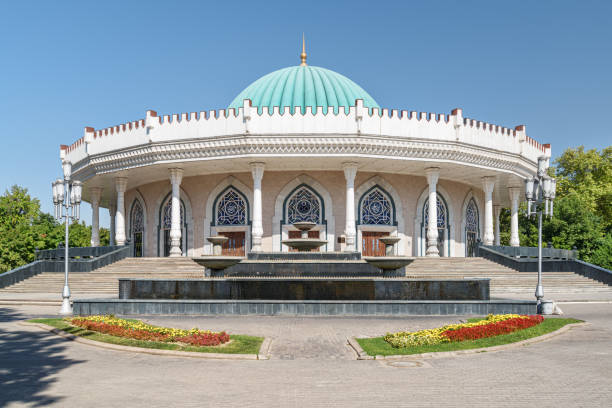
State Museum of History of Uzbekistan
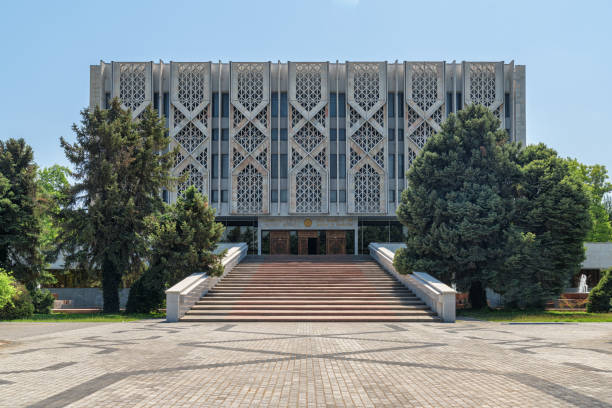
The Museum of History of Uzbekistan in Tashkent was opened at the end of the 19th century, in 1876. The exposition, spread across the two upper floors of a hall of 2,500 square metres, has accumulated 250,000 rare objects reflecting the role of the Uzbek people in the history of humanity from ancient times to the present day. Today it occupies the premises of the Lenin Museum, built in the 1970s in the style of late Soviet modernism intertwined with traditional ornaments. The central location on Rashidov Avenue allows combining a visit to the museum with such within walking distance attractions as Amir Timur Square and Boulevard, Independence Square, the Romanov Residence, the Navoi Theatre and the Russian Drama Theatre, and the "Blue Domes."
The museum collection contains the following funds:
- Archaeology and history — tools of the early Palaeolithic era, iron-age and ceramic, glass and wooden utensils, copper mirrors, bronze cauldrons of the Saka epoch of the 4th century BC, the Buddha sculpture "Triada," weapons
- Numismatics — the history of coinage in various historical periods and states of Central Asia
- Ethnography and art history — embroidered tubeteikas, paintings, miniatures, a collection of antique dolls in traditional Uzbek costumes, stone, clay and ganch sculptures, porcelain and faience, jewellery and chasing — read more via the link.
Tashkent Railway Museum
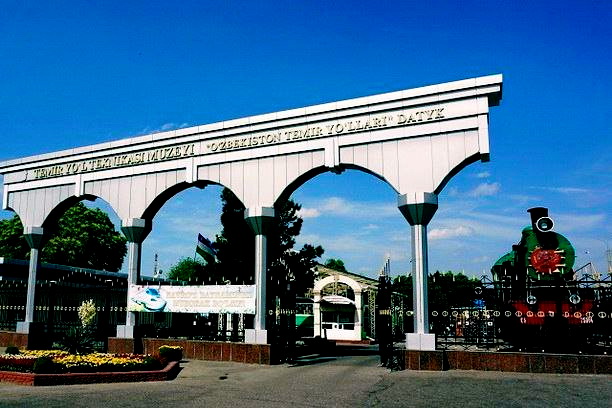
The Tashkent Museum of Railway Technology is better known among the people as the Museum of Steam Locomotives. Opened in the capital in 1989 to mark the 100th anniversary of the Central Asian railway. Admire the locomotives, coursing through history — a glimpse at 13 steam locomotives, 17 diesel locomotives and 3 electric locomotives. For the museum exposition no building was constructed — it is spread across three carriages. A narrow-gauge railway operates with summer excursion carriages in Eastern style, delighting children — set off on an excursion with the whole family. Read more
PERFECT FOR WALKS
Amir Timur Square
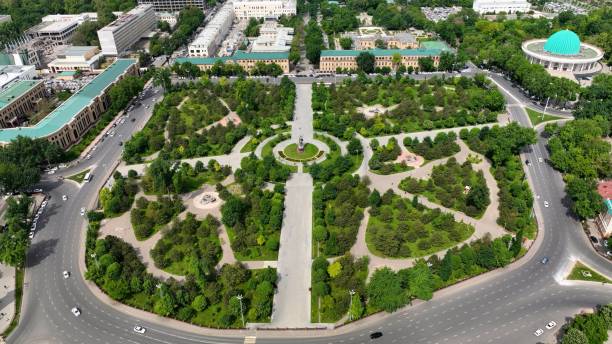
Whatever object you might consider the main symbol of the city, one is invariably so — Amir Timur Square is the very heart of the new, "European" part of Tashkent, formed in the 19th century during the rule of the Russian Empire. All 8 of the city's first Tashkent streets and 2 large avenues — Kaufmanskiy and Moskovskiy — radiate from it like a ring of radial arrows, repeating the routes of the Great Silk Road.
Originally called "Konstantinovskiy Square" in honour of General-Governor Konstantin von Kaufman — the leader of the Turkestan Campaign. Before Independence it was called "Revolution Square" — now it bears the name of the celebrated medieval commander and statesman Amir Timur. As all the roads of the city converge at the centre of the square bearing his name, so 27 states, from the Caucasus to China, Siberia and India were united by him into a single empire with its capital in Samarkand. The monument rising above the complex hints at this meaningfully — the equestrian monument where Tamerlane is depicted on horseback — in Tashkent he is most often seen in this way in the pre-sunset hours. The inscription on the monument, left in 4 languages as a testament to descendants, reads: "Strength is in justice." The most popular spot here for photographs.
The windows of the complex of countless cells look out onto the famous Soviet-era Uzbekistan Hotel, sheltered by the shadow of a curved modernist monolith park zone. Muscovites will recognise in its form the Cosmos Hotel at VDNKh — but the Tashkent hotel appeared several years earlier.
The gates of the complex, leading towards the "Broadway" alley, are framed by the buildings of the men's and women's gymnasium of 1875, built by architect Yanchevsky, in whose buildings the Tashkent Law Institute is now located.
The Tashkent Chiming Clock towers (click and read more) are one of the recognisable symbols of the city. They represent a clock tower with a ciferblat, brought as a military trophy from Prussia as a gift to the capital.
The ensemble is complemented by the buildings of the Timurids Museum and the Forum Palace, gleaming with blue-and-white domes — read more.
Tashkent Zoo — Closeness to the Natural World
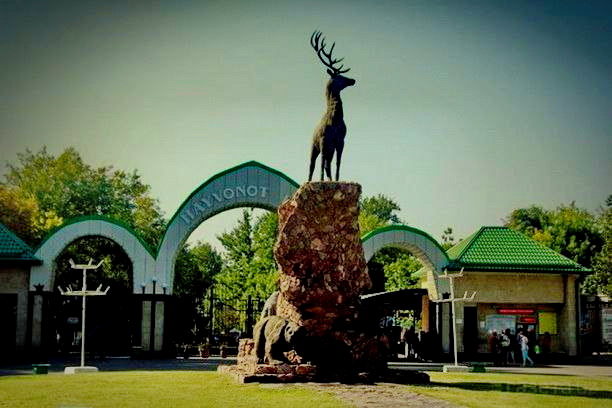
Tashkent Zoo will celebrate its 100th anniversary next year! The new zoo with a vast green space of 21.5 hectares opened in 1997 in the Yunusabad district and neighbours the Botanical Garden. It is home to 373 species of animals.
Explore the exhibitions — read more.
Tashkent Botanical Garden named after Academician Rusanov
The enchanting botanical garden represents 65 hectares of green space, densely planted with 6,000 exotic plants from every corner of the planet. Some of them are listed in the Red Book. Founded in 1950 on the initiative of Soviet botanist Fyodor Rusanov, author of a series of scientific studies on the relocation and adaptation of plants.
The variety of plants is divided into 5 thematic zones of corresponding flora, along which guided tours are conducted — via the link.
Babur Ecopark in Tashkent — a nature zone in the city centre
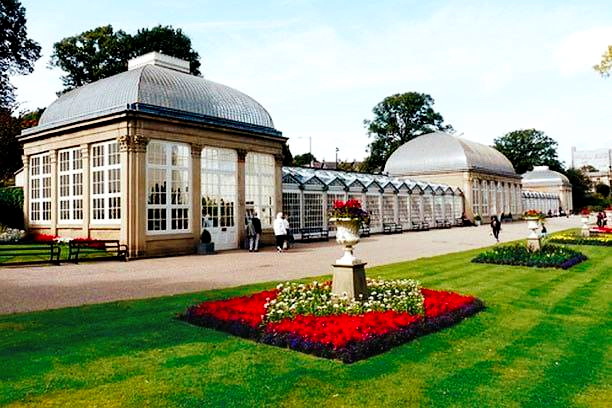
When you want to escape from the concrete jungle but have no chance of allocating even a couple of hours for a trip — set off with the whole family to the first Ecopark in Uzbekistan in Tashkent. The well-equipped zone has spread across the territory of the former zoo, in a lively neighbourhood not far from Amir Timur metro station. From it not only the lush vegetation has been preserved, but also a pond with an island and a modernised bridge. The fountain has undergone reconstruction and now overflows with flowers. The entrance is from two sides — one from the exit of Hamid Olimjon station of the Chilanzar line, the other opposite the Catholic church — read more.
National Alisher Navoi Park of Uzbekistan and Magic City
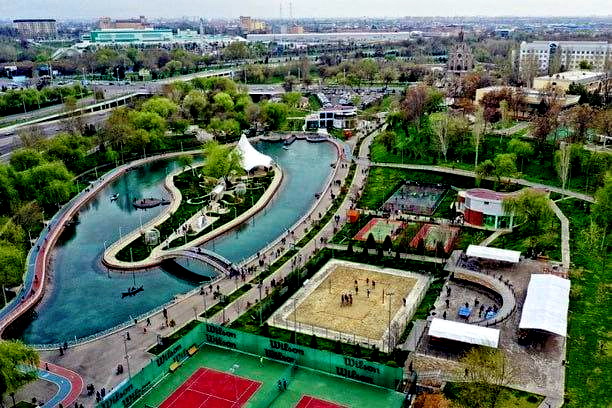
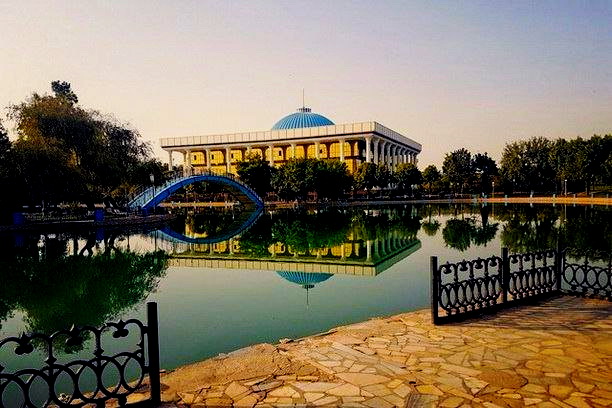
The National Park of Uzbekistan — formerly "Milliy Bog" — occupies an area of 65 hectares, of which 9 hectares are given over to the "Komsomolskoye" ornamental lake. Efforts to lay out the park began back in the Soviet era, in 1932, when it was named the Central Culture and Leisure Park of the Lenin Komsomol. Prior to that, it was the site of the Pervomaisky ("May Day") carriage plant. In the years of independence, the park was renamed in honor of the great Uzbek statesman and man of letters Alisher Navoi — today it is here that the sessions of parliament are held, known in Uzbekistan as the Oliy Majlis.
The park is home to a museum and a tourist landmark of national significance — the 16th-century Abulkasim-Sheikh madrasah, occupied by an exhibition of the Tashkent Handicrafts Association "Hunarmand." Along the alleys, beneath a variety of trees with intertwining crowns, stand monuments to Uzbek writers such as Abdulla Kadyri, Aybek, Gafur Gulom, Oybek, Sharaf Rashidov, Maksud Shaykhzoda, Alexander Fainberg, and others. Among them, on a hill, rises a monument to Navoi himself, placed on a rotunda surrounded by columns.
The park offers wonderful views for a stroll, since the "Komsomolskoye" lake, fed by the Burjar Canal, is located right at its center and can be seen from any point in the park. In summer, the sandy Kumlik beach opens for the season, while in other seasons boat rental remains available on the lake.
In 2021, part of the park's territory was set aside for the Magic City project — the largest all-season amusement park in Asia, with 15 types of attractions for children, unique of its kind for Tashkent. On 20 hectares stand representations of famous landmarks, the Tower Bridge with Big Ben and Regent's Park, as well as a musical fountain, a laser cinema, and a shopping center, a school of professions with a chocolate factory, the first underground city in the country with a depth of 3.8 meters in the style of a bygone era, home to 100 species of exotic fish divided across 12 zones, and a food court. The food court features renowned brands: Shashlyk.uz, a restaurant of Uzbek cuisine Chorlar, and a café of the Turkish chain Kofteci Ramiz on the veranda.
Central Park — Mirzo Ulugbek Central Park of Culture and Leisure (formerly Telman Park)
Telman Park is one of the oldest in Tashkent. It opened on June 24, 1934, and for nearly a century has remained a favorite spot for family recreation, entertainment, and grand national celebrations. During the wartime evacuation years, it served as a point for the distribution of free food.
Children are delighted by numerous attractions — spacious green areas for walks, equipped with benches. Every weekend, a special show program awaits guests here, featuring performers in costume, a variety of show programs with soap bubbles, a Lego show, musical performances, dance master classes, contests, and craft fairs. To satisfy a quickly rising appetite, a whole gastronomic boulevard is provided, beautifully lit with lights in the evening. Read more.