





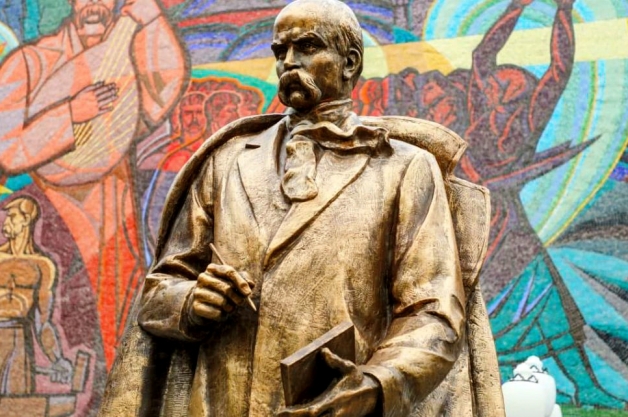
Taras Shevchenko monument in Tashkent
Ukrainians in Uzbekistan
Located on the street that bears his name, the monument to Taras Shevchenko in Tashkent stands as a symbol of the deep historical and cultural ties between Ukraine and Uzbekistan.
According to archival records, the first Ukrainian settlers arrived in Uzbekistan as early as the 18th century, but their numbers increased significantly after the Russian Empire’s conquest of the Turkestan region in 1865. Ukrainians began to establish themselves in fertile areas near the Syr Darya River and the intermountain Fergana Valley, while exiles were often relocated to the barren Hunger Steppe. Over time, Ukrainian communities also formed in Samarkand and Bukhara, with schools offering instruction in the Ukrainian language. A further wave of migration came during World War I, when Galician prisoners of war were sent to Turkestan. As of the 2010 census, 86,000 ethnic Ukrainians were recorded as residing in Uzbekistan.
Shevchenko’s Legacy in Uzbekistan and Central Asia
Taras Shevchenko Street in the heart of Tashkent was built by Ukrainian volunteers who came to assist the city in one of its darkest hours—the aftermath of the 1966 earthquake that devastated much of the old city. With united efforts, people from across the Soviet Union helped give Tashkent a new face and its residents new hope.
The monument to Taras Shevchenko, sculpted by renowned Tashkent-based artist Leonid Ryabtsev, was officially unveiled on December 20, 2002, during an official visit by Ukrainian President Leonid Kuchma, who attended the ceremony in person. The unveiling followed the placement of a commemorative stone two years prior, in the presence of the leaders of both nations.
Ryabtsev is also known for his sculpture of Ajiniyaz Qosiboy uli, a celebrated Karakalpak poet whose work speaks to the hardships endured by his people.
The monument serves as a tribute to Taras Shevchenko, Ukraine’s national poet, writer, thinker, artist, ethnographer, and symbol of Ukrainian identity.
Shevchenko in Central Asia
Few know that Shevchenko himself travelled to Central Asia as part of an expedition to the Aral Sea, exploring what is now northern Karakalpakstan. Deeply inspired by the journey, he produced 87 paintings in just one year, depicting the arid landscapes, desert villages, native animals, and nomadic life of the region. One of his poems, “Behind God’s Door Lay an Axe”, was inspired by the sacred "jangiz-agach" trees of the steppe—solitary desert trees honoured by nomadic tribes, decorated with ribbons, and home to nesting birds.
In his painting “Fire in the Steppe”, Shevchenko captured a blazing disaster he witnessed while travelling from Orsk in Russia’s Orenburg region to Raim in present-day Kyrgyzstan. This experience also made its way into his prose work “The Twins”, and his watercolour of the Karabutak Fortress—a castle-like structure on a riverbank in Kazakhstan—is preserved to this day. His work also documents a visit to the tomb of the warrior Dastan, reflecting his deep interest in the region’s folklore and history.
Design and Cultural Significance
The statue is a half-figure bronze sculpture mounted on a grey granite pedestal, adorned with stylised Ukrainian folk ornamentation and rich in symbolic detail. Shevchenko is depicted in a long coat and short cape, garments appropriate to his historical period. In his left hand, he holds a notebook or journal—a nod to his legacy as the father of modern Ukrainian literature. Instead of a traditional nameplate, the pedestal features Shevchenko’s original signature, engraved in elegant script.
On March 9, 2014, the 200th anniversary of Shevchenko’s birth was officially celebrated in Tashkent with a solemn flower-laying ceremony attended by the Ambassador of Ukraine, the Ministry of Foreign Affairs of Uzbekistan, and members of the Ukrainian diaspora. Attendees recited Shevchenko’s poetry in Ukrainian, with translations presented in Uzbek and Crimean Tatar.
The Mosaic and School Connection
Directly across from the monument is a mosaic mural by artist V. Kutkin, which further enhances the site’s cultural value. The mosaic decorates a wall of a public pool adjacent to School No. 110, which also bears Shevchenko’s name. The school was designed by Ukrainian architect I.Yu. Karakis.
The mural echoes themes from Shevchenko’s works and personal history—depicting both the suffering and triumphs of the Ukrainian people. Scenes include serfs harvesting wheat yet unable to feed their children, the yearning for freedom, and the resilience of family life. Shevchenko is depicted with a kobza, a traditional Ukrainian lute-like instrument, symbolising his role as the "voice of the people."
The mosaic’s message underscores the importance of preserving cultural memory, and of art as a timeless force that connects generations and unites nations.
With its central location, thoughtful design, and emotional resonance, the Taras Shevchenko Monument in Tashkent is a place of pride for Ukrainians in Uzbekistan and a meaningful cultural site for both locals and visitors alike.