




State Museum of Arts of Uzbekistan — Tashkent
The largest and oldest art museum in Central Asia, founded in 1918, the State Museum of Arts of Uzbekistan holds within its walls one of the most remarkable and least-known collections in the world. This is not a regional curiosity — this is a genuinely world-class institution that happens to sit at the crossroads of civilisations, and whose collection reflects that geography in every hall.
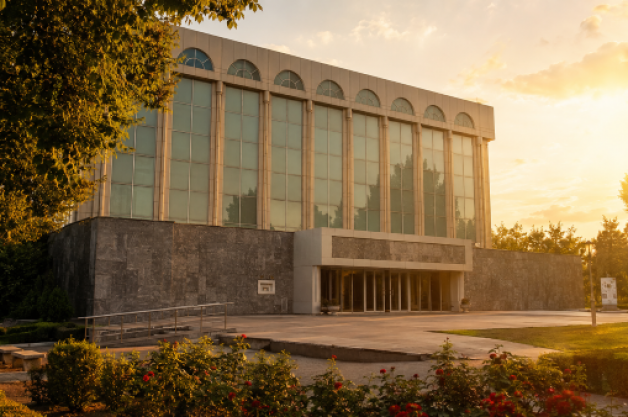
The modern aluminium-clad building with a grey marble plinth was built in 1974. Panoramic glazing floods the interiors with soft natural light — a considered architectural decision that serves the art rather than competing with it.
The Collection: Where East Meets West
The original cubic modernist building with its understated facade conceals an extraordinary exposition: treasures of ancient Central Asian and antique marble sculptures, an impressive collection of Russian avant-garde artists, Peredvizhniki and Western European paintings, Japanese ukiyo-e woodblock prints, graphics, ceramics, Chinese porcelain and glowing Eastern jewellery.
A journey through the four-storey museum moves through 3,000 exhibits that mirror the cultural heritage of Uzbekistan across the full arc of its development — from antiquity to the 20th century.
A Royal Foundation
The museum's collection was initially formed from the rare artistic holdings of Grand Duke Nikolai Konstantinovich Romanov — grandson of Russian Emperor Nicholas I, who was exiled to Tashkent by his own family for a scandalous love affair and spent the rest of his life here. He became the city's greatest benefactor: building irrigation canals, financing public works, and amassing one of the finest private art collections in the Empire. Five hundred exhibits were bequeathed to the city he had come to love and displayed in his palace after his death.
Over the following century, the collection was enriched with acquisitions from Russian museum collections. Today it holds a first-class collection of Russian avant-garde — the founding fathers of abstractionism, Vasily Kandinsky and Kazimir Malevich, as well as the expressionist Yavlensky. Alongside them hang works of the Peredvizhniki movement, Western European masters and — a genuine surprise — Japanese ukiyo-e prints, their delicate lines and flat colour fields looking entirely at home in this crossroads collection.
The Uzbek Masters
From 1935, the formation of Uzbek art collections began. The exposition features creative works by Benkov, paintings by Karakhana, and landscapes of Samarkand, Bukhara and Tashkent by Ivan Kazakov — artists who looked at this ancient land with fresh eyes and captured its light, its colour and its particular quality of silence in a way that no photograph can replicate.
The collection of decorative and applied arts is equally extraordinary:
- Copper-chased vessels and knives from Chust — everyday objects elevated to art through the mastery of craftsmen working with horn handles and engraving
- Bukharan gold embroidery "zardozi" — made exclusively for the nobility, considered the most precious gift a person could give or receive
- Jewellery from every major craft region of Uzbekistan — "golden brows" tillya-kosh, sarsazan hairpins, kuk-rakt-umor chest and shoulder ornaments, and kapitbogi hair decorations — each piece a complete vocabulary of a regional aesthetic
- Ceramics from the workshops of every major craft school across Uzbekistan — Rishtan blue, Gijduvan brown, Samarkand turquoise
- Wooden carved rosettes with images of fruits, flowers, carpets, palas, and khanатlas fabrics woven at the end of the 19th century from mulberry silkworm cocoons
Masterworks You Will Not Expect to Find Here
The museum displays works that would command attention in any major European institution. Among them:
The "Bather" by Andrea Belloli — displayed in the residence of the Romanovs. Beside it hangs an expressive portrait of the "Preacher" by Konstantin Makovsky, the first work to greet guests, and a painting by the finest Italian master of light and colour, Paolo Veronese — "The Lamentation of Christ." Do not be surprised to encounter "Princess Tarakanova" by Konstantin Flavitsky — the original is in the Tretyakov Gallery in Moscow, but the copy in Tashkent was made by Flavitsky himself, whose descendants lived in the capital of Uzbekistan.
The greatest treasure of the collection is "Venus with an Apple" by Antonio Canova — a sculpture with a remarkable backstory. Prince Romanov, travelling through Rome with his beloved — dancer Fanny Lear — was captivated at first sight by a work he encountered in Canova's studio and immediately commissioned an exact copy. The difference lay in a detail: in the original Canova used the image of Polina Borghese — Napoleon's sister — while Nikolai Konstantinovich wished to immortalise in marble the face of his own muse. Thus the geography of Canova's work, beginning in Italy, spread to the Louvre, then the Hermitage, and reaching beyond Europe found itself in Eastern Turkestan.
One more source of pride: an original collection of ceramics by Pablo Picasso, consisting of 12 pieces.
Opening Hours: 10:00 — 17:00
Address: Amir Timur Avenue, 16 (landmark: Minguruk metro station)
Phone: +998 71 236 74 36, +998 71 236 34 44
The State Museum of Arts of Uzbekistan is not a detour from your Tashkent itinerary — it is a reason to come to Tashkent in the first place. Allow at least two hours. Bring the kind of attention you would bring to the Prado or the Hermitage — because the works here deserve exactly that.