





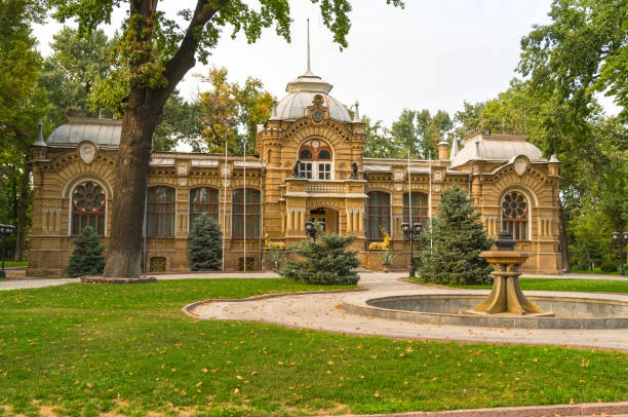
Romanov Palace Tashkent
The "Little Peterhof" beside Independence Square
The Palace of Grand Duke Nikolai Konstantinovich Romanov is one of the most captivating places in the Tashkent — a place shrouded in an aura of mystery. Vaulted halls, cast-iron spiral staircases, bright stained glass windows, ornate iron grilles, high spires of decorative towers — it seems this jewel of 19th-century architecture has only recently hosted lavish balls. Despite the closed territory, handed over to the Ministry of Foreign Affairs for receptions, it is worth taking a little time to walk around it and examine the architecture — unusual for Asia. This place breathes history — and history here is astonishing and extraordinary.
Life "Before": A Prince Who Had Everything
The young years of the Prince — grandson of Russian Emperor Nicholas I — were not only carefree but promised him a brilliant future. He became the most successful graduate of the Military Academy of the General Staff, leaving with a silver medal. His career began with service in the Horse Guards Regiment, where he became a squadron commander.
The Grand Duke possessed a lively, inquisitive mind. He was a passionate traveller, collector of art objects and antiques. Finding himself in Turkestan for the first time in 1883 as part of the Khivan Campaign, he was captivated by the atmosphere of the East — the fortresses of Khorezm and Ichан Kala in combination with the boundless deserts — in memory of which he brought back a row of paintings, books and cast-iron statuettes. For the courage and heroism shown during the campaign, the resistance to which was ferocious, he received the Order of Saint Equal-to-the-Apostles Prince Vladimir.
How Did Prince Romanov End Up in Tashkent?
Nikolai Konstantinovich found himself drawn into a murky affair that changed his life.
Three large diamonds disappeared from the frame of a wedding icon of the Prince's parents, which the Emperor had personally blessed for their marriage. The jewels were soon discovered in a St. Petersburg pawnshop. The investigation that followed divided researchers: some believe that Nikolai Konstantinovich deliberately took the blame upon himself to save a close person from inevitable execution. Others believe the theft was fabricated to remove yet another potential heir to the throne, conveniently appropriating his share of the inheritance in the process. The truth, most likely, will remain forever hidden beneath the veil of time.
There was, however, one circumstance in the Prince's story that was utterly "pulling at the heartstrings" — his love for women. His background, charisma, sharp and boundless generosity, combined with his status as the "first handsome man of the dynasty," ensured him invariable success in affairs of the heart. In his youth he did not miss a single ball, and at one of his favourite venues he became acquainted with an American dancer of Philadelphia origin under the pseudonym Fanny Lear — whose real name was Harriet Blackford. The preceding romance had by this time begun to take an inconvenient turn for the imperial family. Fanny had completely turned the Prince's head, which did not escape the attention of his relatives. Such a person with free morals was in no way suitable as a companion to a representative of the crowned family. And she became the main motive cited for the crime — in the family's version, the Prince, infinitely in love with the dancer, decided to steal in order to shower his beloved with lavish gifts.
Fanny Lear was expelled beyond the borders of the Empire with a life sentence banning her return. The Prince could not obtain either an acquittal or forgiveness. By decision of the imperial council he was deprived of all privileges associated with rank, along with the deprivation of property, and as a consequence lost the legal right to defend his own family. To avoid scandal, he was declared mentally ill and sent into exile first to the Crimea, then to Orenburg. In the Southern Urals he committed yet another "unheard-of audacity" — despite the ban on entering into marriage, he went to a secret wedding ceremony with the daughter of a local police commissioner, Nadezhda Alexandrovna Dreyer, and soon a son was born to them. Almost 10 years after the assassination of Emperor Alexander II, his exile ended on special permission of the Russian Empire — he was permitted to move to beloved Tashkent and take his family with him, though still without receiving his rank and recognition. Thus Prince Romanov found himself in Tashkent, where he lived almost forty years, until his very death.
Upon arriving in Tashkent he immediately engaged in active social work, benefiting society — investing his own funds in the development of the Hungry Steppe. His influence touched cultural life too — Nikolai Konstantinovich gifted the city the Khiva cinema, named in memory of his first visit to Turkestan.
The Tashkent Residence: History and Architecture
The landscaping of the territory was carried out by the famous Tashkent botanist Krauze. Originally planned with wide alleys, the estate is now surrounded by two-hundred-year-old plane trees and oaks, rustling with an antique fountain with figurines of frogs, crocodiles, statues of deer and dogs.
The construction of a single-storey palace in the style of late modernism of elongated form was led by Russian architects Wilhelm Geizelman and Alexei Benois. The palace is built of grey-yellow fired brick — characteristic of traditional Tashkent material.
The project came out as a duplex — with "western" and "eastern" wings. The concept was maintained even when housing honoured guests. The eastern wing represented a painting of ornaments that were not copied from already existing examples but were the result of the creative re-interpretation of decorators, most vividly manifested in the design of the stained glass windows in the same style. Additional decoration was provided by exclusive Bukharan, Afghan and Turkmen hand-woven carpets.
The double-leaf doors and the finishing of the entrance hall are made of dark wood — a lantern descending from the ceiling on a chain adds atmosphere to the décor. The same finishing was used for the dining room, but supplemented with cornices and suspended gilding. The crockery was made from Chinese porcelain on a special commission by the Imperial Factory in St. Petersburg. Walking through the hall you find yourself in winter and Japanese gardens with bridges and miniature fruit trees, and climbing the circular staircase — in the library.
The palace is divided into "male" and "female" halves — consonant with Eastern tradition. The staff worked and lived in the basement rooms with windows; the enormous kitchen was also located here.
"The Treasury of the Arts"
The Prince took direct part in construction, and his main requirement was the presence of the necessary space and suitable conditions for housing the collection of paintings and marble statues — no less than 3 halls were allocated for it. The treasury of art objects moved to the residence in 1981 and on Romanov's initiative became the centre of arts and the first art gallery of Central Asia, accessible not only to the aristocratic class but to ordinary citizens. Visiting the residence was an extraordinarily exciting event for the townspeople, to which they carefully prepared and dressed up. Excursions were also conducted by the Prince himself — with the ease of a person who knew both the objects themselves and the history of their appearance in the collection.
The palace is located in the very centre of the city, opposite Independence Square, on Rashidov Avenue. Until 1995 the building stood next to the Iosif-Georgievsky Cathedral, where the Prince found his final resting place. Before his death, in 1918 he bequeathed the palace and the entire collection of art objects to Tashkent — the city that had become a new home for him, where he lived in honour and love. Having lost the regalia associated with his bloodline, he immortalised his name in memory, and the glory of his deeds continues in hearts.
In the newest history of Tashkent, the Romanov Palace may return to the role that the Prince bequeathed for it — to serve as a temple of art. Local authorities have already announced their intention to return the architectural masterpiece to open public access, and a preparatory process of reconstruction has begun, connected with the strengthening of the subsiding foundation and the positioning of the building in a seismically active zone. At present the Prince's collection is displayed at the Museum of Arts of Uzbekistan.