





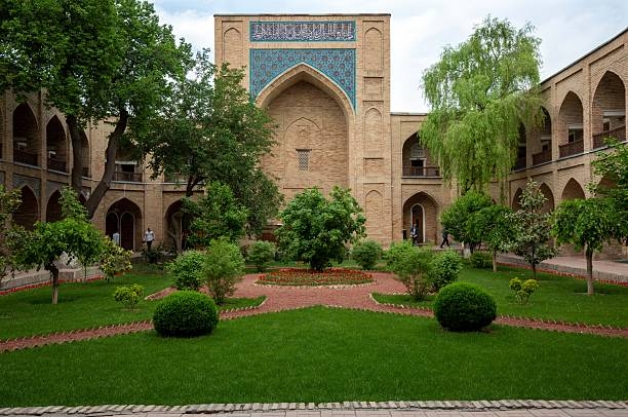
Kukeldash Madrasah Tashkent
A century ago there were 23 madrasahs — Islamic educational institutions — in old Tashkent. Among them Kukeldash was the most prominent: both in scale and in location. The choice of site for its construction was deliberate — on an elevation where at the turn of the 10th century one of the three main city gates stood, "Vrota Kesha." This is a symbol of the superiority of spiritual life and knowledge over everyday routine, underscoring the value of education. Built in 1569 by Barak-Khan and Dervish-Khan, vizier of the Sheibanid dynasty under the nickname "Kukeldash" — "Milk Brother" — i.e. brothers nursed by one and the same woman — as part of the capital's Registan, the central ensemble of the city.
A Century of Turbulent History
The fate of the Islamic school was not straightforward. In the 18th century its premises for receiving spiritual education were repurposed as a caravanserai for trade — which brought the building to a deplorable condition, the result of which was the collapse of the crowning towers "guldastas." In the 19th century the building took on a different role: it served as a fortress for the Kokand Khans, and also as a place for public executions — as a warning to uphold moral standards.
The height of the main portal is 15.7 metres — it suffered the greatest damage during the destructive earthquakes of 1866 and 1886. The formerly gleaming blue domes and the second storey were dismantled brick by brick for other constructions. 100 years of religious academy of restoration awaited — this happened already in the 1960s of the 20th century. Gratifyingly, the portals still bear visible remnants of medieval majolica. The "pandjara" has been preserved — a special lattice designed to protect from the sun, into the patterns of which the sacred names of Allah and his prophet Muhammad are skilfully woven. In other respects the architecture corresponds to tradition — there is an inner courtyard surrounded by rows of "hudzhrs" (cells) for students.
Student Life at Kukeldash
The life of students was organised in equal measure between attention to the educational process, the development of religious consciousness and practical skills. Mudarris — teachers — were selected from among scholars in the field of Islamic theology, philosophy, law and the Arabic language, holding authority in society.
Kukeldash Today
The current building corresponds to its original purpose — on its ancient territory students who have chosen the path of spiritual learning as the direction of their life once again began to be taught. The functioning mosque gathers the faithful for the Friday prayer obligatory for every Muslim.
Located within walking distance of the eastern Chorsu market, the madrasah receives hundreds of tourists within its walls every day — allowing immersion in the genuine atmosphere of "Eski Shahar" and experiencing the living breath of tradition and history.
Why Kukeldash Matters Beyond Architecture
To stand in the courtyard of Kukeldash is to stand in a place that has absorbed five centuries of the city's life — as a centre of learning, a fortress, a place of public justice and, finally, a place of learning once again. Few buildings anywhere in the world have played so many roles for so long and survived to tell the story. The madrasah is not a ruin preserved behind glass — it is a living institution, where the call to prayer still sounds on Fridays and students still walk the same courtyard that merchants, Khans and scholars crossed before them.
This continuity — the unbroken thread between the 16th century and today — is what makes Kukeldash worth your time, even if you have already seen Samarkand's Registan. Because here, unlike Registan, the building is still in use. The history did not stop.