




Independence Square Tashkent — Mustakillik Maydoni: History & Guide
Some squares exist for ceremonies. And some squares exist for people. Mustakillik Maydoni — Independence Square in the heart of Tashkent — is both at once, and that rare combination is precisely what makes it worth your time.
Two Thousand Years of History in One Address
The land on which Independence Square stands has always been the centre of power. For centuries, on the banks of the Ankhor Canal, the main administrative buildings of each ruling era occupied this site. Before the Russian conquest of Tashkent in 1865, the residence of the Kokand Khan stood here. After the Empire arrived, it was replaced by the "White House" — residence of the Turkestan Governor-General — and military parades were held here for the first time. The square's original name was "Sobornaya" — Cathedral Square — because the Orthodox Spaso-Preobrazhensky Cathedral stood directly opposite.
After the October Revolution the cathedral was demolished, the square was renamed "Krasnaya" — Red Square — and in 1934 a monument to Lenin was erected. The headquarters of the Council of People's Commissars of the Uzbek SSR was built on the site of the White House.
In 1954, as part of a reconstruction programme, the beloved fountains that Tashkent residents and visitors still love today appeared. Two years later the square was renamed from "Krasnaya" to "Leninskaya."
The devastating 1966 earthquake significantly altered the appearance of the square — a major reconstruction was required. Eight years later, its size had tripled.
After Uzbekistan gained independence in 1991, the square was renamed Mustakillik Maydoni — Independence Square — symbolising the country's newfound freedom and national identity. The Lenin monument was replaced by the Independence Monument — a globe with the raised contours of Uzbekistan, expressing the aspiration towards integration with the world community.
What You Will See
The Independence Monument — a globe at the centre of the square, with the outline of Uzbekistan engraved upon it. Simple in form, powerful in meaning. The central fountain differs from all others on the square: it is white — and is called "Ok Yul," meaning "Good Path."
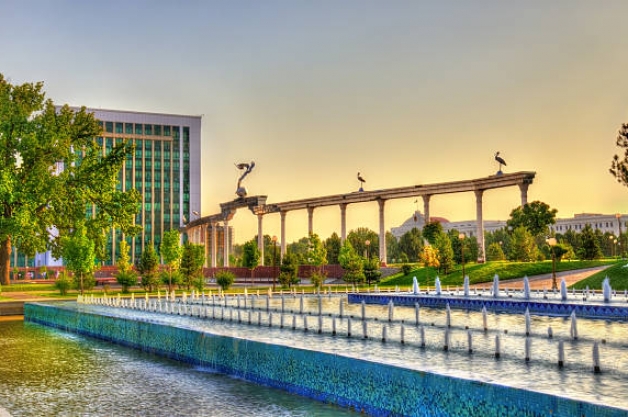
The Ezgulik Arch — sixteen white marble columns visible from a distance, crowned by storks rising towards the sky. The stork is an ancient Eastern symbol of gratitude and peace. The arch represents "Good and Bright Aspirations." A new Tashkent superstition has already formed around it: make a sincere wish here and the storks will carry it to the heavens.
The Grieving Mother Monument — on the opposite side of the square from the government buildings lies the Avenue of Memory and Honour, dedicated to Uzbekistanis who died heroically during the Second World War. Created in 1999 on the site of the 1975 Memorial to the Unknown Soldier. Along the alleys — galleries framed by carved wooden columns in national style. In the niches: Books of Memory — on golden pages, the names of soldiers, sons and daughters of the Uzbek people who did not return from the war. Before them an eternal flame burns. The Eternal Flame. On 9 May the President of Uzbekistan arrives here to lay flowers, and thousands of citizens follow his example.
The Rodina-Mat (Motherland) Sculpture — designed in 2006, it stands apart from similar monuments across the CIS. Instead of the traditional sword, the woman holds a child in her arms — reflecting the peaceful young state and the priority of traditional family values. The authors are celebrated Uzbek sculptors Ilkhom and Kamol Dzhabbàrov, who also created the monument to Amir Timur in the namesake Tashkent square.
More Than a Monument
Independence Square is simultaneously the central venue for state holidays and national celebrations — including Independence Day on 1 September and New Year, with its invariable attribute the Presidential Christmas tree — and simply a beloved recreational space for the city.
The square's 12-hectare recreational zone, with its cascading fountains and shady alleys, draws Tashkent residents on hot summer evenings. In the 1990s the pool was actively used by local children for swimming — now it more often serves as a location for photo sessions, with pedestrian paths running around the perimeter creating beautiful reflection effects.
Since 2014, Labour Day on 1 May has also been celebrated in Uzbekistan as Fountain Day — the fountains of Mustakillik Maydoni mark the occasion, and the square becomes the most beloved gathering place for Tashkent residents on the first spring day.
For children, carousels are set up during celebrations, street performers appear, and musical and dance ensembles perform. The square lives, breathes and belongs to the city in a way that few such formal spaces manage.
When to Visit
Any time of year — but Independence Square has three unmissable moments:
- 9 May — Day of Memory and Honour: the most moving and intimate of the square's ceremonies
- 1 September — Independence Day: the grandest celebration of the year
- A summer evening — when the fountains are lit, and half of Tashkent comes out to walk