





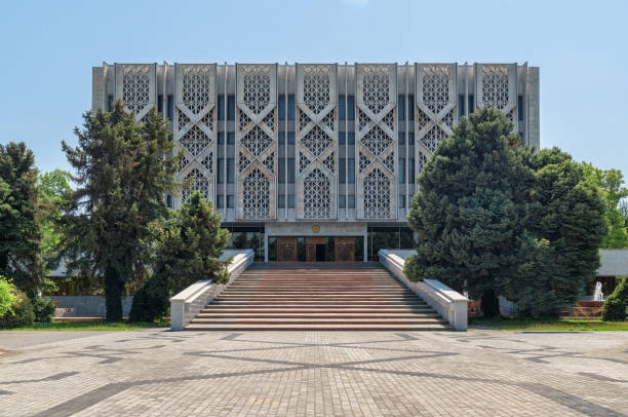
State Museum of History Uzbekistan
The State Museum of History of Uzbekistan in Tashkent was opened at the end of the 19th century — on 12 July 1876 — as the People's Museum of Turkestan. The initiators of its creation were the Turkestan branch of the Moscow Society of Natural Science Enthusiasts, Anthropology and Ethnography. The current name and four-storey building the multi-profile institution received in the 20th century.
This is a special place in the capital — one of the oldest and largest — where visitors can immerse themselves in the astonishing history of our Central Asian home and make a journey through significant eras of its formation, trace its development and learn about new bright events of the passing epochs through its exhibition galleries.
The exposition, spread across the two upper floors of 2,500 square metres, has accumulated 340,000 rare objects reflecting the role of the Uzbek people in the history and culture of humanity from ancient, prehistoric times — the birth of civilisation in the Middle Ages to the present day.
Today it occupies the premises of the Lenin Museum, built in the 1970s in the style of late Soviet modernism of a unique cubic form, intertwined with traditional facade ornaments. The central location on Rashidov Avenue allows combining a visit to the museum with such within walking distance attractions as Amir Timur Square and Boulevard, Independence Square, the Romanov Residence, the Navoi Theatre and the Russian Drama Theatre, and the "Blue Domes."
What to See: A Selection of the Best Collections
Archaeology and History — 60,000 artefacts: tools of the early Palaeolithic era, iron-age and ceramic, glass and wooden utensils, copper mirrors, bronze cauldrons of the Saka epoch of the 4th century BC with figurines of animals, the stone Buddha sculpture with two monks — "Triada" from Fayaz-Tepe, thousand-year-old weapons.
Here is presented an archaeological find from the Seljung cave in the Fergana Valley in the south of Uzbekistan — the remains of a primitive human, giving an understanding of the "childhood" of humanity, its perception of the surrounding world and interaction with it in the Palaeolithic period — more than five thousand years ago. The cave floor is more than a thousand square metres, and its location in a fertile valley surrounded by mountains explains the choice of this place as a permanent dwelling for ancient people.
Also in the territory of the Fergana Valley, near the village of Sox, archaeologists discovered yet another phenomenal artefact — a stone carving representing an amulet with the image of two snakes. A memorable symbol of the collection, skilfully crafted from black chrysotile by an unknown master. The painstaking artistic work reflects the developed degree of magical thinking of the valley's inhabitants four thousand years ago and the complexity of ritual practices.
What can a bronze brooch cast three thousand seven hundred years ago at Sаpallitepa — a monument of the Bronze Age excavated in the Surkhandarya region — tell us? It is decorated with an exquisite miniature of a mountain goat — a mouflon — standing before a stylised human figure. Such motifs speak of closeness to the natural world characteristic of tribes leading a settled way of life and engaged in farming and cattle breeding.
Numismatics — the history of coinage in various states of Central Asia, beginning from the 5th century BC to the 19th century: dariks of the Achaemenids, antique coins of the Macedonian, Seleucids and silver coins of the Greco-Bactria, tetradrachms of Kushan, coins of Khana and Bukharan oasis, tanga of the Chinghizids and Tsarist Russia. The collection is revealed in 80,000 finds of European-Russian and Asian origin, testifying to the vast scale of geography, trade and monetary circulation on the Great Silk Road. The museum's custodians will tell you how one or another collection came to them — besides archaeological excavations these were gifts from local and foreign museums, transferred as gifts to the collection of Tashkent residents and even seized at customs on attempts to secretly export the treasures from the country.
Ethnography and Art History — 16,000 masterpieces: embroidered tubeteikas and national costumes, paintings, miniatures, a collection of antique dolls in traditional Uzbek costumes, stone, clay and ganch sculptures, works of porcelain and faience, jewellery and chasing. Pearls of the collection — a faceted amulet from the Fergana Valley depicting two snakes, created in 2000 BC, as well as valuable fragments from the Afrosiab settlement dating to the 7th–8th centuries.
The Museum Floor by Floor
1st floor — temporary exhibitions of "touring" collections from other museums
2nd floor — from the beginning of time to the rule of the Timurids. Special attention is paid to the period of the Golden Age of Islam in Uzbekistan, when here, after the collapse of the Arab Caliphate, science, architecture, literature, craft and art flourished. The museum displays unique exhibits connected with the work of great Uzbek artists, scholars, masters and poets.
3rd floor — divided between the legacy of the Bukharan, Khivan and Kokand Khanates
4th floor — reproduces the newest history, from the 19th century to the present day. The central leitmotif of the collection is the ideology of Jadidism — Islamic modernism opposing the conservative direction of Kadimism, which became irreconcilable opponents on questions of enlightenment and mass education of the Uzbek people. Here you can also acquaint yourself with their published newspapers and journals.
The museum is extremely popular with guests from Australia, Japan and South Korea.
For the Curious: Beyond the Exhibition Halls
At the museum a special children's department operates, where you can try yourself at archaeological excavations at an imitation of the Kampyrtepa settlement, master the basics of national pottery, miniature painting or mulberry silkworm cultivation. You can breathe life into traditional dolls in an improvised theatre.
Having been impressed by the examples of applied art, you can acquire a contemporary work in ceramics, embroidery, miniature or goldsmithing in the souvenir shop located on the same territory.
Address: Rashidov Avenue, 3
Phone: +998 (71) 239 17 79, 239 17 78, 239 10 83
Opening hours: 10:00 to 17:00, Tuesday to Sunday