





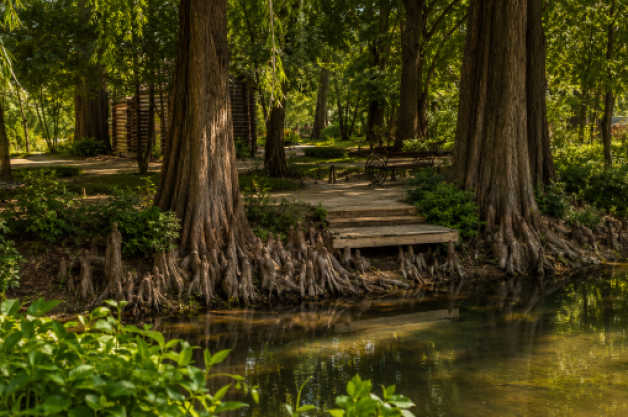
Tashkent Botanical Garden named after Academician Rusanov
The enchanting botanical garden represents 65 hectares of ecosystem, densely planted with 6,000 exotic plants from every corner of the planet. Part of the captivating collection is listed in the Red Book. The garden was founded in 1950 on the initiative of Soviet botanist Fyodor Rusanov, author of a series of scientific studies on the relocation and adaptation of plants — but it seems as though this natural masterpiece has always been here.
The variety of plants is divided into 5 thematic zones of corresponding flora, along which guided tours are conducted:
- Far East
- North America
- Europe
- East Asia
- Central Asia
Each sector has its own distinctive microclimate. Rather like a round-the-world journey within the boundaries of the capital.
The Tashkent Botanical Garden holds second place in the CIS and is the largest in Central Asia. The magnificent collection of coniferous forests, ornamental and fruit trees, flowering plants and berry bushes is fed by the embracing canals of Akkurgan and Salar. The charm of the oldest park is in its untamed wildness — a natural untouched density in the truest sense of nature — which is why only the main pedestrian paths are asphalted here.
To stop for a wonderful moment and linger in the peace that envelops your soul — surrender to contemplation on one of the countless benches. The Botanical Garden, with its evergreen cypresses and lush meadows, is attractive for visiting at any time of year, and in the warm seasons becomes a popular picnic location — it is "dark" from the shade and cool here even on scorching days. And the only place in Tashkent where you can see the enchanting beauty of a winter forest covered in snow, and along the way enjoy the meditative rustle of autumn leaves.
The wonderful place in spring blooms with snowdrops which, by virtue of the warm climate, appear on the surface not through snow caps, but their flowering brings no less joy and delight even amid green lawns.
Already at the entrance guests are greeted by a colourful carpet of flowering chrysanthemums, magnolias and daffodils, ficuses and eremuruses. The canopy is closed by the intertwining crowns of sequoias, growing here just as tall as in their homeland — on the Pacific coast. Here even drought-resistant acacias thrive in their wild grandeur, tropical sprawling cotton trees and tulip trees delight with their honey aromas and please the eye with flowers.
Washington palms, arriving from the south-west of the USA, also demonstrate their unpretentiousness, growing on Uzbek soil to a height of 25 metres. Catalpa trees are not to be found anywhere else in Tashkent. Yet another remarkable zone — the Uzbek-Chinese onion garden, flowering almost seven days a week.
Wandering around, you will inevitably come across one of five lakes decorated with water irises. The first of them — to the left of the greenhouse towards the arena, surprising guests with its appearance. During the pandemic it was used for holding entrance examinations for the institute. The simplest way to find the second lake — follow right from the entrance, keeping to the boundary with the zoo. On the same side is located the most popular attraction of the garden — the Wishing Tree on the hill, decorated with thousands of ribbons. To find the rest, you will have to explore.
Nothing prevents independent walks here, but the territory is so vast that it is easy to get lost. A guided tour will help not only to admire the surrounding natural beauty but also to extract benefit — learning, for example, to identify trees. Here 3 laboratories work, engaged in the development of new varieties, a greenhouse, an orangery with a rare collection of tropical and subtropical plants, and a special nursery for 800 species of medicinal herbs. All these zones are open to visitors — and we recommend taking advantage of this for lovers of houseplants — you will receive valuable recommendations on care from local specialists.
Opening hours: daily 09:00 to 18:00; from June to September the working hours are extended by one hour, to 19:00
Address: Bogishamol Street, 232, opposite the Zoo
Phone: +998 71 289 10 93