




Museum of Applied Arts Tashkent
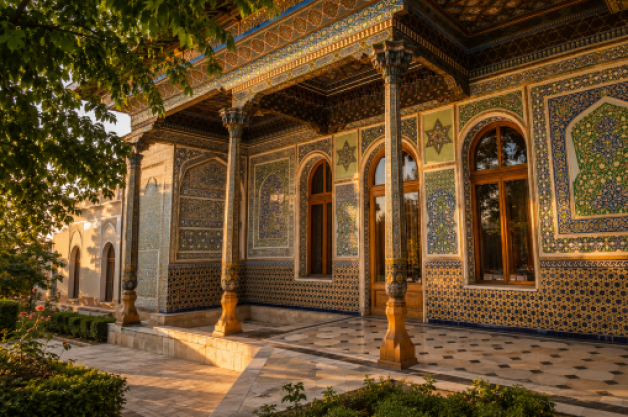
There are museums you visit out of duty. And there are museums that stop you in your tracks before you have even crossed the threshold. The State Museum of Applied Arts of Uzbekistan belongs firmly to the second category — because the building itself is already a masterpiece.
The Building: A Palace Mistaken for an Emir's Residence
Founded in 1937 in a historic palace commissioned by entrepreneur Nikolai Ivanov, the museum occupies one of the most beautiful buildings in Tashkent. The impressive design — decorated with intricate wood and ganch carvings — was enriched with a magnificent painted ceiling by Russian diplomat and ethnographer Alexander Polovtsev the Younger. Such celebrated masters as Tashpulat Arslankupov and Bukharan artist Usta Shirin Murodov worked on its interiors.
Not knowing its purpose, you could easily mistake the building for the residence of an emir. That is precisely the point. This is not a neutral white-walled institution — it is a work of art that houses works of art, and the dialogue between the two creates something genuinely rare.
The museum is within walking distance of the city centre, not far from Kosmonavtlar metro station.
The Collection: 7,000 Reasons to Stay Longer Than You Planned
The museum holds 7,000 irreproducible examples of Uzbek applied art — a chronicle of the development of artistic talent and craft labour from the beginning of the 19th century to the present day. The collection, represented by craft schools of Tashkent and Samarkand, Bukhara, Surkhandarya and Syrdarya, Fergana and Karakalpakstan, demonstrates the regional distinctions and cultural characteristics of each area — an education in Uzbek geography told entirely through objects.
The exposition is divided into the following collections:
- Rare silk carpets — each one the work of a year or more; in former times owning one was considered extraordinary luxury
- Hand-woven fabrics — the ikat silks of Uzbekistan, with their distinctive flame-like patterns achieved through resist-dyeing before weaving, were carried by Silk Road caravans across continents to decorate the castles of European rulers
- Jewellery — gold and silver work from every major regional school, each with its own vocabulary of symbols and techniques
- Knives — from Chust, the knife-making capital of Uzbekistan, where blades have been forged for centuries and horn handles engraved with patterns that identify their maker's village
- Paintings and miniatures — the continuation of a tradition of manuscript illustration stretching back to the Timurid courts of the 15th century
- Musical instruments — dutar, rubab, doira, tanbur — the instruments of the classical Uzbek musical tradition, displayed alongside visual documentation of their use
- Lacquer ceramics — so lustrous they were used exclusively as decorative objects, never for everyday life
The Embroidery: A Language Written in Thread
A special place in the collection belongs to suzane — large embroidered panels hand-crafted from cotton, silk and gold threads. These were not decorative objects in the modern sense. Every home had them. Every girl embroidered her own suzane on the threshold of marriage — the patterns encoding wishes for fertility, protection and prosperity. The embroidery also adorned national clothing, tubeteikas, turbans and even boots.
To own a fine suzane in former times was to own something that had absorbed months or years of a woman's life, her intentions and her skill. The price reflected this accordingly. The finest examples were carried by Silk Road caravans across continents to decorate the palaces of European rulers — and examples of Uzbek embroidery can be found today in the collections of the Victoria and Albert Museum in London and the Louvre in Paris.
The museum's collection allows you to trace the evolution of this tradition across regions — each school with its own colour palette, its own preferred motifs, its own way of organising the composition.
A Note for Travellers
Allow at least ninety minutes. The building alone warrants thirty. Go slowly through the embroidery collection — the scale of the work only becomes apparent when you look closely. If you are travelling with children, the knives and musical instruments tend to be the most compelling stops.
The museum shop carries some of the finest examples of contemporary Uzbek applied art available in Tashkent — considerably better than the souvenir markets, and with the provenance to match.
Opening Hours: 10:00 — 17:00, closed Monday
Address: Rakatboshi Street, 15 (near Kosmonavtlar metro station)
Phone: +998 71 256 43 42