



Amir Timur Square Tashkent — Silk Road Heart of the City
Every city is not simply a complex of buildings and motorways — it is a living organism. The heart of Tashkent is Amir Timur Square, from which 8 arteries, the main avenues of the city, radiate outward. If you engage your imagination and listen to the depths of history, you will catch the voices of camel drivers, the creak of wheels and the rustle of fabrics. Because here, in the very heart of the capital, four roads of the Great Silk Road intersected, passing through the ancient provinces of China to Kokand.
The History of the Square: From 1882 to the Present
The chronology of the square begins in 1882. Tashkent was becoming the capital of the Turkestan Military District and was rapidly transforming thanks to the decrees of Governor-General Mikhail Grigoryevich Chernyayev. Thus Chernyayev ordered the laying out of a park in the centre of the city, which was to be supplemented by a nearby bank, educational institutions and a teachers' seminary. The complex of these buildings has been preserved to the present day.
In 1913 a monument to Governor-General Konstantin Petrovich Kaufman was erected, however its existence was short-lived. In 1917 the monument was destroyed, leaving only the pedestal. Over the years it faithfully served as a plinth for the most varied of monuments — to Lenin, Stalin, Marx, and also to the corresponding symbols of their times.
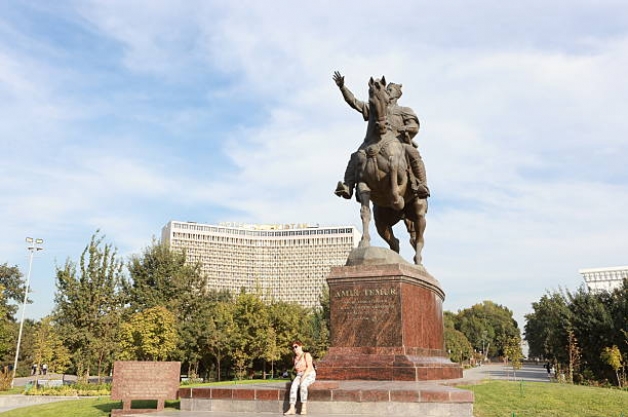
The bronze figure of Tamerlane on a rearing horse took its permanent place on the pedestal in 1993. The author of the monument was sculptor Ilkhom Djabbarov. On the pedestal in four languages the famous phrase of the commander was inscribed: "Strength is in justice." Changes touched the square too: the alleys were widened, fountains were installed, fresh flowerbeds blossomed. The square bears the name of the great commander. Tamerlane is known throughout the world as a conqueror who did not lose a single battle and who defeated the Golden Horde. In Uzbekistan he is revered also for his enormous contribution to culture and science.
What Surrounds the Square
A walk around the square is a double pleasure. Here you can not only enjoy the recreational zone with lawns, fountains and green plantings, but also get acquainted with notable buildings around the park.
In the building of the former women's gymnasium the Tashkent State Law University is now located. The gymnasium was built in the 19th century by decree of Governor-General Kaufman; in Soviet times it was transferred to Tashkent State University, and after Uzbekistan gained independence — to the Law Institute.
Next to the Law University — the bright azure dome of the Amir Timur Museum. The museum was opened to mark the 660th anniversary of the birth of the commander and is now a mandatory point of visit. To learn everything about the history of Tamerlane and the Timurid states, to see a copy of the Quran of Uthman valued by rulers of great states, and to admire the magnificent interior — this is what must be done here without fail.
The eternal companions of Amir Timur Square — the Tashkent Chiming Clocks. Since 1947 they have helped city residents know the exact time and serve as a meeting place. The clock mechanism arrived as a military trophy from distant Eastern Prussia. The clocks were brought by a hereditary clockmaker Sergeant Alexander Eizenstein and gifted to the city.
On the other side of the square, deserving the attention of every person walking past Amir Timur Square, is the Forum Palace, erected in 2009. This monumental structure impresses with its scale and embodies the finest architectural solutions in national and contemporary style. In the grand conference hall important political meetings and international forums take place — for example, the SCO Summit.
Next to the Forum Palace stands the Uzbekistan Hotel, which Tashkent residents among themselves call the "Uzbekchka." The building in the form of an open book was built in 1974 and fits perfectly into the landscape of the square.
How to Get There
Address: Yunusabad district, Amir Timur Square (next to Amir Timur Khiyoboni metro station)